
Every spring it’s the same discovery: the rose buds and the soft new veggie tips wear a coat of tiny green (or black, or grey) passengers. And every spring, a lot of gardens respond with a spray that solves aphids for a fortnight — and quietly deletes the ladybirds, lacewings and parasitoid wasps that would have solved them for the season. This article is the no-spray playbook. Not because purity, but because for aphids specifically, the no-spray methods genuinely work better by Christmas.
Know what you’re looking at
Aphids are soft-bodied sap-suckers, always clustered on the newest, softest growth — rose buds, tomato tops, the flush on a potted lemon. (Their fellow sap-suckers run the same playbook — scale, mealybugs, and on lilly pilly hedges the psyllid.) They excrete sugary honeydew, which explains the two side effects: sticky leaves that grow black sooty mould, and ants running highways up the stems (ants farm aphids for the sugar, and will actively defend them). A few aphids are nothing. A mob bending the new growth is worth ten minutes.
Check for one thing before acting: mummies and monsters. Bloated bronze aphid husks are parasitoid wasp work; small black-and-orange crocodile-shaped insects among the colony are ladybird larvae — each one eats hundreds of aphids. If the predators have arrived, the problem is already being solved by professionals. Stand down.
The playbook, in order
1. The water jet. A hard hose blast knocks aphids off; most never make it back. Repeat every couple of days for a week. On rose bushes and sturdy shrubs this alone usually ends the outbreak. (Morning, so leaves dry — the fungal-disease rule.)
2. Fingers. On veggie tips and single stems, run thumb and forefinger along the cluster. Ten seconds, done, deeply satisfying.
3. Prune the worst. A heavily infested single shoot can simply leave the premises — into a sealed bag or hot compost.
4. Break up the ant protection racket. If ants are farming the colony, control the ants’ access (sticky barrier bands on trunks, find and fix what else attracts them) and the aphids lose their bodyguards; predators move in fast after that.
5. Recruit permanently. Predators stay where there’s habitat: flowering plants among the veggies (alyssum, coriander gone to seed, daisies) feed adult hoverflies and lacewings whose larvae do the killing. A garden that never sprays builds a standing army — which is why year two of this approach is easier than year one.
Why not just use a spray — even a “natural” one?
Because nothing about a spray knows the difference between an aphid and a ladybird larva sitting in the middle of the colony, eating your aphids. That includes home-made and low-toxicity options: anything that suffocates or poisons soft-bodied insects takes out the beneficials on contact, and the aphids — who reproduce far faster than their predators — win the rebound every time. It’s the treadmill: spray, rebound, spray again. If an infestation ever genuinely overwhelms the methods above (rare on healthy plants), whatever you choose to use is governed by its registered label — but try the hose first. It’s free, it’s immediate, and the bees don’t attend the funeral.
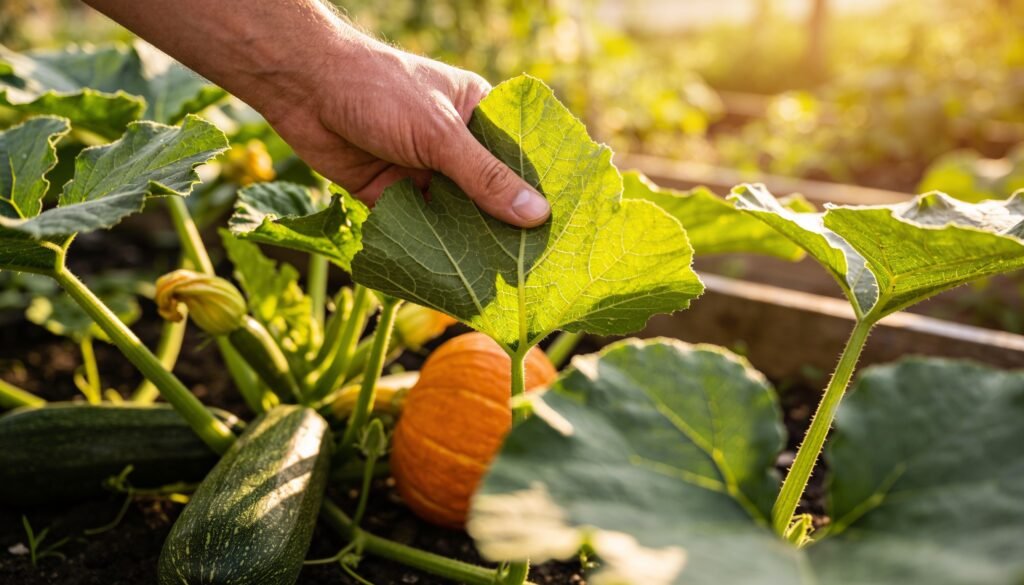
One prevention note: lush, over-fertilised growth is aphid caviar. Feed steadily rather than heavily and there’s simply less soft tissue on offer — the same even-growth principle that keeps citrus leaf miner manageable. And while you’re patrolling with the hose, pollinate your zucchini — you’re out there at the right time of day anyway.
Related: Lilly Pilly Pimples: Psyllids, and Whether to Fight or Replant.

 By anastasnowla@gmail.com
1 Comment
[…] Related: Aphids on Roses and Veggies: Control Without Killing Your Bees. […]