
For Australian small spaces, a dwarf lemon or lime is a sensible starting point if you have a sunny position and can keep up with container care. Dwarf fruit trees save canopy space; they do not promise supermarket-sized harvests. Choose fruit you use, check what makes the tree dwarf, and treat stone fruit’s winter requirements as a separate decision.
What does “dwarf” actually mean?
A dwarf tree may be a naturally compact variety or a familiar fruit variety grafted onto a growth-limiting rootstock. A tree described as suitable for pots may simply tolerate pruning and container growing. Those descriptions are not interchangeable.
Ask for the variety, rootstock and expected mature spread, including whether the quoted size assumes regular pruning. Height alone misses branches pushing into a doorway or across the only sunny seat.
For citrus, Flying Dragon is one dwarfing rootstock used by Australian growers. Smaller growth can still carry full-sized fruit, as Engall’s Nursery explains. That describes fruit size, not how many you will pick. A small canopy has a smaller working leaf area, and an undersized pot adds another constraint.
Which dwarf varieties deserve a look?
This shortlist uses kitchen usefulness, manageable space and the ability to buy a clearly identified tree as its criteria. It is not a tested yield ranking.
| Choice | Why consider it? | Check before committing |
|---|---|---|
| Meyer lemon on dwarfing rootstock | Useful if lemons regularly go into your cooking | Confirm the dwarfing rootstock; the name Meyer alone does not guarantee a dwarf tree |
| Tahitian lime on dwarfing rootstock | A modest picking can still be useful for a household that uses limes | Check local performance and the space needed for its mature canopy |
| Dwarf mandarin | Worth considering when fresh eating matters more than cooking | Ask about the named variety’s harvest period and pollination needs |
| Compact peach or nectarine | An option for a gardener particularly keen on stone fruit | Verify both compact habit and local winter suitability |
Daleys’ dwarf citrus descriptions include Meyer and Tahitian options. Use nursery descriptions to identify the planting material, then assess your own space; catalogue enthusiasm is not a household harvest forecast.
A lemon you use regularly can earn its place with modest pickings. A mandarin may need to deliver more fruit at once to feel worthwhile to your household. Neither is inherently better: start with what you would enjoy harvesting.
Why is stone fruit a bigger decision in Queensland?
Dwarf does not mean low chill. Compact branches solve a space problem; winter chilling requirements concern the tree’s seasonal development. Queensland research treats low chilling requirement and compact habit as separate traits in subtropical peach breeding.
For south-east Queensland and subtropical northern NSW, seek a locally demonstrated low-chill selection rather than buying a compact peach on appearance. Hort Innovation’s breeding report specifically covers low-chill stone fruit in this growing region. Ask whether the exact variety crops in conditions like yours, not merely somewhere in Queensland.
For temperate districts and cool highlands, match the named variety to local winter conditions; a low-chill label is not automatically an advantage. For tropical lowlands, treat a dwarf peach or nectarine as a specialist choice needing local evidence before purchase.
Chill-hour figures are deliberately not supplied here. A generic number on a shopping page cannot settle suitability for every suburb, elevation or sheltered courtyard. If the nursery cannot explain the local match, leave that tree off the shortlist.
How much fruit should you honestly expect?
Budget for supplementary pickings, not household self-sufficiency. A recently purchased tree may arrive carrying fruit, but that crop does not establish what it will produce after moving into your pot and position.
During establishment, prioritise healthy roots, foliage and a sound branch framework. A small tree struggling under fruit may benefit from having some removed. Once established, assess performance across several crops rather than judging it by one disappointing harvest.
Sunlight, watering consistency, root room, pollination and variety all affect the result. Before buying any fruit tree, check whether it needs a compatible pollination partner. A purchase that requires another tree changes the space calculation immediately.
Avoid promised kilograms or a guaranteed first harvest date. Without the tree’s age, growing conditions and management history, those numbers would offer false precision.
What makes fruit trees in pots workable?
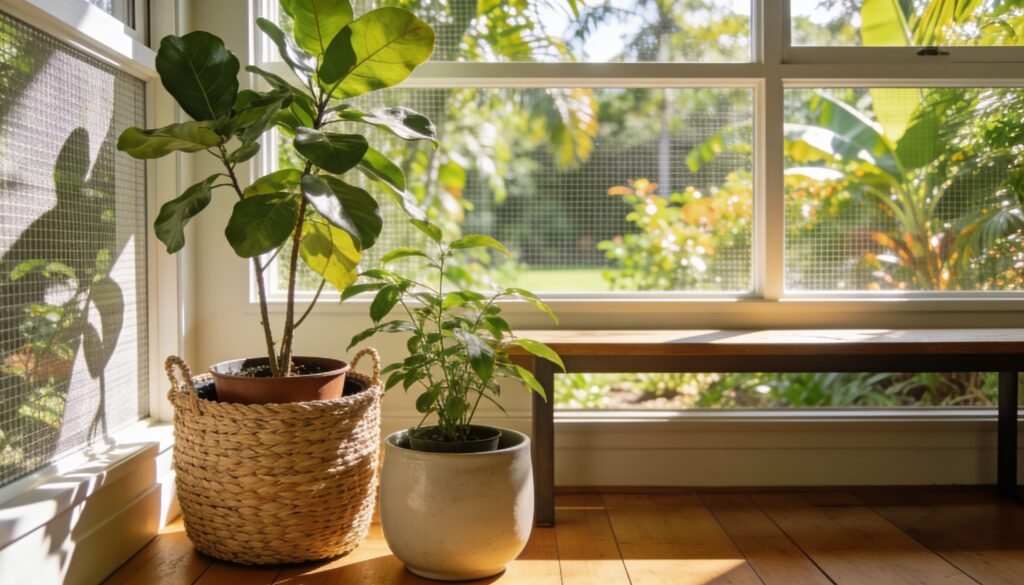
Start with the position. Trace the actual direct light reaching the leaves, including shade from roofs and neighbouring buildings. The guide to reading balcony sunlight helps distinguish a bright-looking corner from a useful growing position.
Then plan the container around the tree’s root ball and future growth. Use a stable pot with open drainage holes and container potting mix. Keep the original planting depth, and leave room to water without spilling mix over the rim. There is no single pot size that suits every dwarf tree for life.
Check moisture within the mix before watering, then wet the root zone thoroughly and allow excess water to drain. Reassess as conditions change; a fixed weekly calendar cannot account for wind, heat or a growing canopy. Feed according to the label, and investigate poor growth before assuming more feed is the answer.
Keep companion planting modest. Filling the tree’s pot with hungry vegetables adds competition and complicates watering. Give other crops their own containers using these crop-by-crop container choices.
What should you choose first?
Choose one clearly identified dwarf citrus if its fruit suits your kitchen and the position suits citrus. Choose stone fruit only after resolving the local winter match and pollination requirements. Leave space to reach the pot, inspect the leaves and harvest without moving everything else.
Before buying, map the available room and watering access with the practical small-space setup guide. A tree earns its spot when caring for it fits your routine and the fruit gets used.

 By anastasnowla@gmail.com
2 Comments
[…] Related: Small-Space Fruit: Dwarf Varieties That Earn Their Spot. […]
[…] reading: Small-Space Fruit: Dwarf Varieties That Earn Their Spot and No-Dig Garden Beds: Build One in an […]