
Mulch is one of the cheapest ways to cut watering and weeding, which is why it is so often overdone. Most mulching problems come from a handful of repeat mistakes, not from mulching itself.
This is a checklist for beds that already have mulch or are about to get it. For a deeper look at trees specifically, see the guide to mulch volcanoes and tree mulching mistakes.
Mistake 1: How deep is too deep?
Heaping it on is the most common error. The sources vary a little, so here is the range:
- Gardening Australia says 5 to 7 cm is ideal for all organic mulches.
- The Gardening Australia factsheet says 2 to 6 cm for coarse mulches.
- The Australian Native Plants Society says no more than 75 mm, and warns very thick layers can deoxygenate soil and kill plants.
- A US university extension gives about 3 inches (roughly 7.5 cm) as the ceiling, which is general horticultural advice rather than Australian.
The common thread is a ceiling near 7 cm. Too much mulch can block water from reaching roots and restrict the gas exchange soil needs. The Maryland page adds that roots can grow up into very deep mulch and then die when it dries out.
Fix: measure it. Push a ruler or a trowel into the mulch. If it is deeper than about 7 cm, rake some off. When topping up, check what is already there, since bark breaks down slowly and the old layer may be enough.
Mistake 2: Piling mulch against stems and trunks
The advice is consistent across sources: keep mulch away from stems. Gardening Australia says to keep it clear to prevent rot. The native plants society says not to pile it against stems or trunks. The Maryland extension explains why: mulch touching bark holds moisture against it, which can cause decay and give pests and diseases an entry point.
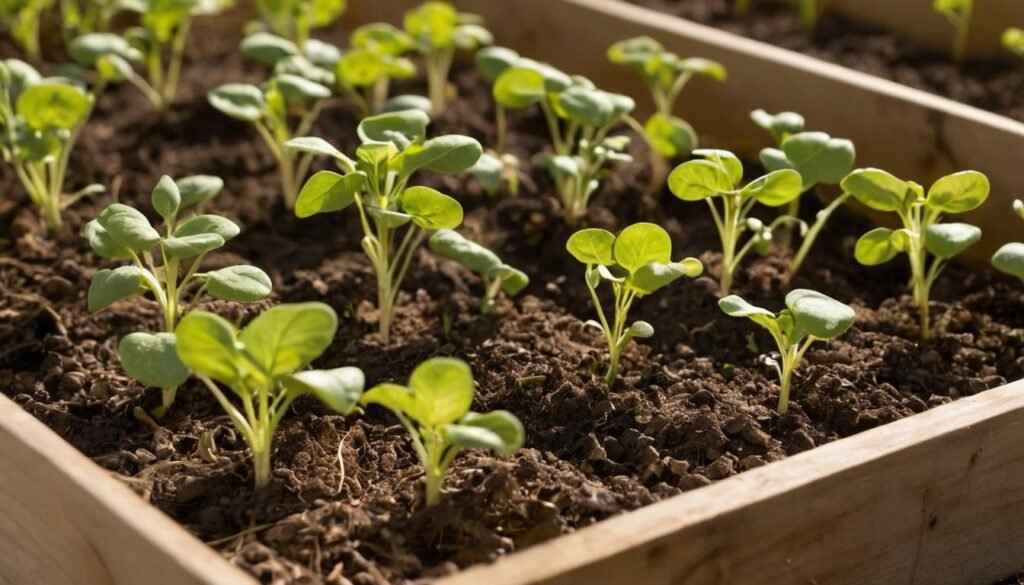
The Maryland page suggests about 3 inches (roughly 7.5 cm) of clearance for a tree or shrub stem. That figure suits a trunk. For a small perennial or seedling a few centimetres of bare soil is a reasonable proportion, though no Australian source gives a number.
Fix: pull mulch back in a ring so the base of each stem is visible and the soil around it is bare. Do this on shrubs, fruit trees, roses and vegetables alike.
Mistake 3: Using fine mulch like it is coarse mulch
Not all mulch behaves the same. Sustainable Gardening Australia describes a trial in which chunky mulch (particles over 5 mm) did best at reducing evaporation and letting water through. Fine mulch did worst. It absorbed over four times more water than the chunky material, so little irrigation reached the roots. The article recommends mixing fine mulches with chunkier material and not laying fine mulch thick, because it can hold water that roots never use and may rot if it stays wet.
Gardening Australia’s factsheet says something similar about bark: medium to coarse grades let water reach the soil, while fine grades absorb moisture and can encourage weed seedbeds.
Fix: choose a medium to coarse grade for general beds. Break up straw and hay clumps so they do not form a mat, as Gardening Australia advises.
Mistake 4: Choosing the wrong mulch for the site
The best mulch depends on what you are growing and where.
- Native plants: the native plants society says to choose mulch to suit the plants’ habitat, with gravel for low-nutrient soils and drier inland species, and organic mulch for rainforest species. SGA says wood chips and bark can draw nitrogen from the soil as they break down, and are better avoided around natives with low nutrient needs. Your regional native plant society can advise on local conditions.
- Vegetable beds: SGA suggests legume straws such as lucerne or pea, noting they may contain weed seeds.
- Dry gravel areas: SGA says rock can absorb heat that may harm plants, and dust collecting in it can let weed seeds germinate.
- Woody mulches in general: Gardening Australia’s factsheet says fresh sawdust, pine bark and woodchips can draw down soluble nitrogen as they break down.
- Bearded iris: the factsheet says the rhizomes need to bake, so they do not suit mulching.
The native plants society also notes that pine bark should be applied only once, and that plain compost breaks down quickly and works better as a soil conditioner under another mulch, a point SGA also makes.
For a full comparison of materials, the guide to mulch types in Australia lays out what to use where.
Mistake 5: Mulching dry soil, or the wrong time
Mulch holds moisture in; it does not add it. Both SGA and the native plants society say to apply it to damp soil. The native plants society adds that new plants should go in before mulching.
Timing is less tightly covered in the sources. Two cautions do appear:
- Winter and seedlings: Gardening Australia notes that in winter, mulch can shelter slugs and slaters that nibble seedlings, so the presenter pulls mulch back in the vegie patch. It goes back on as the weather warms to shield roots from heat.
- Late spring and early summer: this is a sensible window across much of Australia, because beds are still moist and the heat is coming. That is editorial advice rather than a figure from the sources. In the tropics, where the wet season brings constant rain, check that mulch is not sitting waterlogged.
Fix: water the bed deeply first, then mulch. Check after the first rain that water is soaking through.
Mistake 6: Forgetting that water may not reach the soil
The native plants society points out that water applied over mulch may not reach the soil, so check after rain, and that organic mulch can make sandy soil water-repellent. The Maryland extension page says light watering may wet only the mulch while the soil underneath stays dry.
Fix: push the mulch aside after watering and feel the soil beneath. If it is dry, water longer and slower, or run drip lines under the mulch. Water management is covered in the guide to watering Australian gardens.
Mistake 7: Using plastic or fabric underneath
SGA does not recommend plastic or landscape fabric under mulch. Plastic blocks water and air, and fabric, while more permeable, still adds no nutrients. If you want a weed barrier, a thin layer of damp newspaper or cardboard is a common alternative, but check the native plants society’s caution that paper under mulch can attract termites.
Mistake 8: Never topping up, or topping up blindly
Organic mulch breaks down. The native plants society says to top up every 1 to 2 years. The Maryland page says to replace organic mulch only as needed to keep it at its original depth. In practice that means checking depth each year, not adding a fresh bag every spring.
What is established and what is uncertain?
Established by the sources: a depth ceiling near 7 cm, keeping mulch off stems, using coarse rather than fine mulch, applying to damp soil, matching mulch to the plants, and checking that water gets through.
Uncertain or climate-dependent: the best month to mulch in your region, the exact clearance for small plants, how long a given mulch lasts, and whether paper under mulch is worth the termite risk in your area. Check with your local council, native plant society or nursery.
Related reading: Garden Irrigation Maintenance: A Seasonal Checklist for Australia.

 By anastasnowla@gmail.com


1 Comment
[…] Related reading: Common Mulching Mistakes in Australian Gardens. […]