
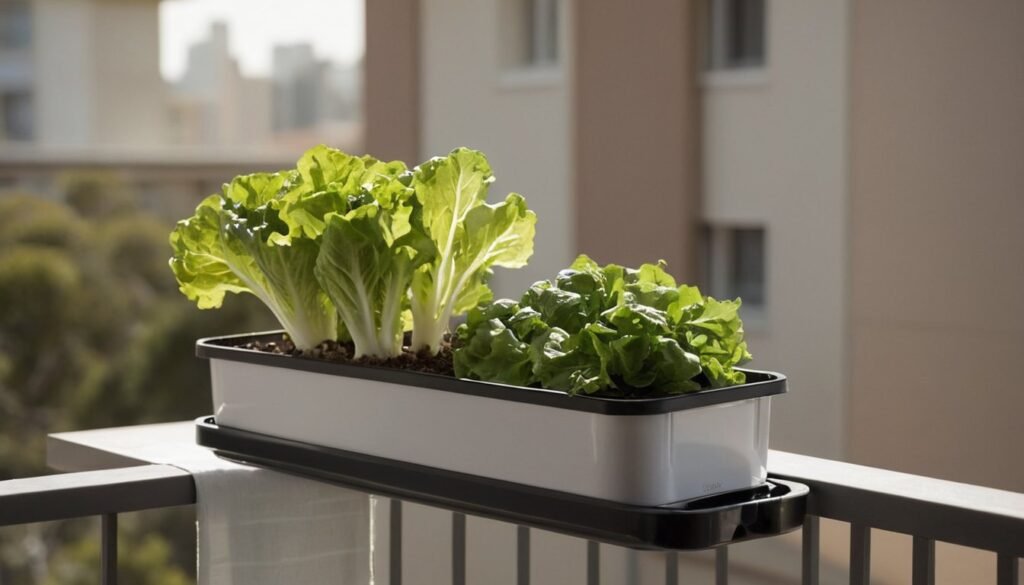
A balcony trough suits salad greens well: sow a loose-leaf lettuce or Asian green fairly thickly, pick the outer leaves, and leave the centre to keep growing. Three things decide success: a trough that stays evenly moist, a bright but not scorching position, and small, regular sowings rather than one big one.
Heat is the main limit in most of Australia. Plan for the cooler months, and switch to heat-tolerant greens for summer.
What size trough do salad greens need?
Lettuce roots are shallow, as the University of Maryland Extension notes, so salad greens do not need a very deep box. I could not verify one agreed minimum depth, so treat any single figure with caution.
Volume matters more in practice. A larger, deeper trough holds more moisture and swings less between wet and bone dry, which is a common cause of bitter, stressed leaves. Choose a trough with drainage holes and fill it with good-quality potting mix rather than garden soil. Timber or light-coloured troughs absorb less heat than dark metal or dark plastic (an editorial rule of thumb, worth remembering on a west-facing rail).
Check the weight of a full, wet trough against your balcony’s limits and your building rules before loading it up.
Which greens work as cut-and-come-again crops?
| Green | How it behaves in a trough | Best season (see zones below) |
|---|---|---|
| Loose-leaf and oak-leaf lettuce | Pick outer leaves repeatedly; oak-leaf types are slower to bolt | Cool months |
| Mizuna, tatsoi, bok choy and other small Asian greens | Fast; outer leaves can be ready in 2 to 3 weeks | Autumn to early spring |
| Silverbeet | Hardy; cut outer leaves; likes afternoon shade in hot climates | Most of the year in mild areas |
| Warrigal greens | Spreading, trailing habit suits a trough edge; must be blanched | Warm months and into autumn |
Heading lettuces are a poor fit. They are cut once, so they do not give the repeat harvest a trough is good for.
For summer, ABC Organic Gardener lists silverbeet, Warrigal greens and Malabar spinach as heat-tolerant options. I could not find a reliable source for Okinawa spinach in containers, so it is not covered here.
Warrigal greens contain oxalates and, per Sustainable Gardening Australia, should be blanched for a minute or two before eating. They also self-seed readily, which is another reason to keep them in a pot.
How do you sow and pick for steady leaves?
- Fill the trough to a couple of centimetres below the rim and water the mix before sowing.
- Sow in shallow rows, fairly thickly, or scatter small seed across the surface and cover lightly. Dense sowing for baby leaves is an editorial practice, not a fixed rate.
- Keep the surface moist until seedlings are through.
- Thin if seedlings are crowded. The Maryland guide suggests 4 to 8 inches (about 10 to 20 cm) for leaf lettuce grown to full size, and the thinnings make a first salad.
- Pick when leaves are a usable size. Take the older outer leaves first and leave the centre, as the Maryland guide describes.
- Pick little and often rather than stripping the plant. Regrowth speed depends on weather and variety.
Common mistake: cutting everything at the base. Some greens regrow, but loose-leaf lettuce does best when you leave the heart intact.
How does succession sowing work?
Sow a small section of the trough every two to three weeks rather than the whole box at once (an editorial interval; adjust to how fast you eat). When one section starts to bolt or tire, pull it out and resow that patch. The Maryland guide recommends successive plantings, or varieties that mature at different times, for this reason.
Seedlings started in a punnet and transplanted shorten the gap and reduce thinning. Refresh the top of the mix with a little compost or new potting mix between rounds.
When should you sow in each climate zone?
Exact dates depend on your suburb and balcony, so treat these as starting points (editorial guidance, except where a source is named).
- Tropical north: sow in the cooler, drier months, roughly autumn to early spring, and use Warrigal greens or Malabar spinach through the wet season.
- Subtropical (south-east Queensland, northern NSW): autumn to early spring for lettuce and Asian greens, in line with the BAAG Asian greens guide, which gives autumn to early spring. Use heat-tolerant greens in summer.
- Temperate (Sydney, Melbourne, Adelaide, Perth): autumn through spring, with summer sowings only if the trough gets afternoon shade.
- Cool climates and Tasmania: spring to autumn, with protection or a bright indoor windowsill for the coldest months.
How do you stop bolting and heat stress?
Bolting is when a plant sends up a flower stalk and the leaves turn bitter. The Maryland guide says long days and high summer heat trigger it, and the BAAG guide adds that Asian greens bolt in heat or when the soil dries out.
What helps:
- Aspect. In the southern hemisphere the midday sun sits in the north, so a north-facing balcony is the brightest. In warm areas, morning sun with afternoon shade suits salad best. A strongly west-facing balcony can scorch greens in summer.
- Shade. The Maryland guide calls shade cloth especially useful in summer. For options, see ways to filter hot afternoon sun on a small garden.
- Moisture. Keep the mix evenly moist and mulch the surface lightly with a fine material such as shredded sugar cane, to cut evaporation.
- Variety. Choose oak-leaf or other slow-bolting types for warm months.
- Accept the end. When a plant bolts, pull it and resow. Sowing lettuce into a hot trough in midsummer is a common source of failure.
How often should you water and feed?
Containers dry out quickly. Iowa State University Extension advises checking with a finger, watering when the top few centimetres feel dry, and never letting the mix dry out completely. It says small containers in hot, windy weather can need water once or twice a day, while large containers in cool weather need it once or twice a week.
Balconies are often windy, so expect the faster end of that range. Water until it drains from the holes, preferably in the morning, as the Maryland guide recommends, so leaves dry during the day. Avoid soggy mix, which invites root and leaf disease.
Frequent watering also washes nutrients out of the mix. Feed regularly with a liquid fertiliser, or use a slow-release product suited to leafy vegetables, at label rates. Pale, slow leaves often point to hunger or uneven watering.
What are the common mistakes?
- Sowing everything at once, then facing a glut and a bolting trough together.
- Using a small, dark trough on a west-facing rail in summer.
- Letting the mix dry out between waterings, then drenching it.
- Ignoring caterpillars. Cabbage-family Asian greens attract cabbage white moth caterpillars; flywire cover, checking leaf undersides and hand-picking are non-chemical options.
- Eating Warrigal greens raw.
For the broader setup of an apartment edible garden, see our main guide to growing food on an Australian balcony. To plan what else your containers can carry, read the wider guide to edibles in pots.

 By anastasnowla@gmail.com

No comment yet, add your voice below!