
A balcony garden in Australia fails for one of four predictable reasons: the pots were too small for our heat, the aspect was misjudged, the wind was ignored, or the setup annoyed the neighbours below. All four are avoidable before you buy a single plant — and none of them requires drilling a hole or risking a bond.
Constraints first (it’s the renter’s superpower)
Before plants, three checks:
Weight. Wet soil is heavy — a large pot can weigh as much as a person. Balconies are engineered with limits, so keep serious weight near the building side rather than the outer edge, favour several medium pots over one enormous one, and use lightweight potting mix (never garden soil, which is heavier and performs worse in pots anyway).
Water runoff. The fastest way to a dispute is dirty pot water raining on the balcony below. Every pot gets a saucer; watering happens slowly, until the saucer just catches the excess and no further. It’s also worth checking your building’s rules — many schemes have by-laws about what can sit on, hang from, or drip off a balcony. That’s a check-your-scheme point, not something any website can answer for you.
Attachment. Nothing that drills, screws or glues. Freestanding shelving, railing planters that clamp (where by-laws allow), and heavy pots that simply sit are all bond-safe and take the garden with you when you move.
Aspect: the make-or-break call
Which way your balcony faces sets what you can grow, and in the southern hemisphere the sunny side is the north — the opposite of every American and British guide the internet will feed you. A north-facing balcony is prime edible-growing real estate; a south-facing one is shade gardening; east is gentle morning sun; west is afternoon blast-furnace that cooks soft plants in January. The full breakdown, including what thrives on each aspect, is in Which Way Does Your Balcony Face? — read it before buying plants, not after some die.
Heat and wind: the two balcony multipliers
Balconies are harsher than gardens. Concrete and glass store and reflect heat, so a 33-degree day is hotter in a west-facing pot than in any garden bed. And wind — the underrated killer — dries pots twice as fast as still air, shreds soft leaves, and tips top-heavy plants. Responses that work: bigger pots (more thermal and moisture buffer — pot size guidance here), mulch on top of the potting mix, grouping pots so they shade and humidify each other, moving the most delicate plants to the sheltered corner, and choosing tough plants for the exposed rail line.
Watering a balcony garden
Pots dry out faster than ground, and balcony pots faster still. The principles from our watering guide still apply — water deeply until it just reaches the saucer, then let the top few centimetres dry before going again — but expect daily attention in summer for small pots, which is itself the best argument for fewer, larger pots. Morning watering beats evening on a balcony: leaves dry quickly and less sits in saucers overnight.
A starter setup that works
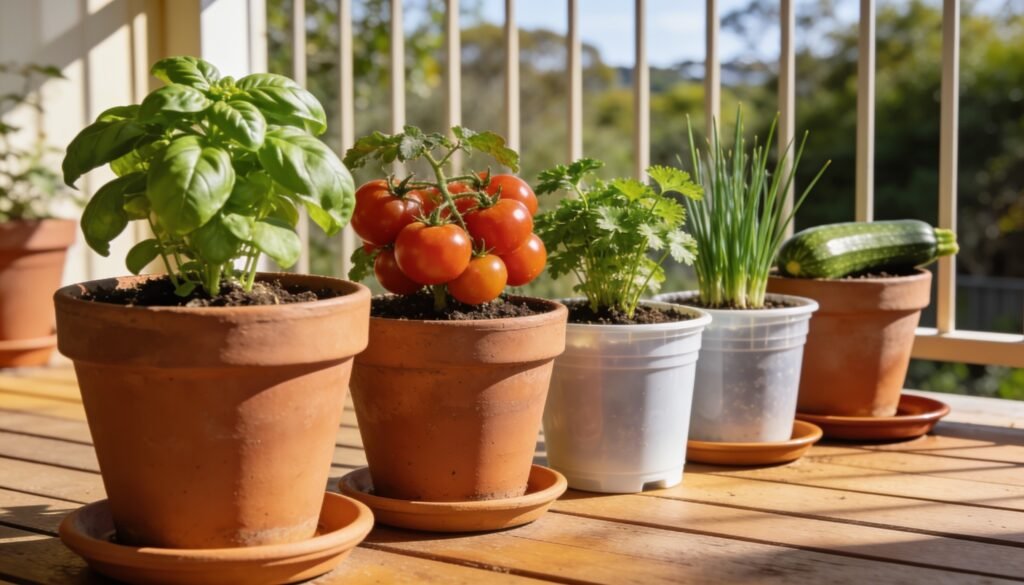
For a first season on a typical balcony: three large pots (herbs you actually cook with; cherry tomatoes in the late-winter or autumn window; a lettuce-and-greens pot in the cooler months), one mid-size pot for something you love the look of, and a strict rule against buying more pots until these four are thriving. Small collections that thrive beat big collections that struggle — and they move house better, too.
The two most useful next reads: what vegetables genuinely work in pots, and your balcony’s aspect. Between those and the watering guide, you have the whole system.
Related: Citrus in Pots: Growing Lemons and Limes in Small Spaces.
Related: Vertical Gardens That Don’t Damage the Wall (or Your Bond).
Related: Self-Watering Pots: How They Work, When They’re Worth It, When They Fail.
Related: Composting in a Small Space: Bins, Bokashi and Worm Farms Compared.
Related: Courtyard Gardens: A Full Garden on a Concrete Slab.
Related: Shade-Only Balconies: What Will Actually Grow Without Direct Sun.
Related: How to Build a Low-Maintenance No-Dig Garden Bed in a Sydney Balcony.
Related: Watering Your Small Balcony Garden with a Hand-held Drip Kit.

 By anastasnowla@gmail.com
No comment yet, add your voice below!