
Every pot on a balcony needs a drainage hole, and the water that leaves it needs somewhere sensible to go. Raise pots on feet, use saucers only if you empty them, and water slowly enough that very little escapes.
Good drainage protects the plant first and your balcony second. A pot that cannot drain rots roots. A pot that drains onto bare tiles stains the floor and can drip on the balcony below.
Why does a pot need drainage holes at all?
Roots need air as well as water. When a pot holds water at the bottom, the potting mix stays saturated and roots suffocate. University of Illinois Extension calls a hole at the bottom of the container “critical”, notes that wet soils favour root rot, and warns that plants rarely recover from it.
The RHS puts it the same way: drainage holes are essential. Both are overseas sources, but the principle is plant physiology, not climate, so it holds on an Australian balcony.
Decorative pots without holes are the usual trap. If you love one, keep the plant in a plain pot with holes and use the decorative pot as an outer sleeve. Lift the inner pot out to water, let it drain fully, then put it back.
Some common mistakes:
- Putting gravel or pot shards at the bottom of a pot with no hole, hoping it will act as drainage. It does not replace a hole.
- Letting a pot sit in a permanently attached saucer or a sleeve that fills with water.
- Using dense garden soil in a pot. A potting mix made for containers drains more reliably.
Should you use a saucer under balcony pots?
On a balcony, usually yes, but with a rule: empty it. A saucer catches water that would otherwise run across the floor. Left full, it keeps the base of the pot wet, which is the same root problem as no hole.
Illinois Extension advises against permanently attached saucers because they are hard to empty, and suggests a detachable one so you can tip out the excess. The RHS suggests a saucer in summer to catch excess water and removing saucers in winter so pots are not left standing in water. That winter advice comes from a cool, wet climate. In subtropical and tropical Australia the wet season brings heavy rain, so saucers under uncovered pots can fill from the sky as well as the watering can. Check them after rain.
Do pot saucers breed mosquitoes?
Standing water can. Water left in a saucer, bucket or planting pot is a place where backyard mosquitoes can breed. The City of Canada Bay Council lists “the pockets of water in buckets and planting pots” as breeding sites and advises regular flushing of pot-plant bases or filling them with sand.
That council page does not give a number of days. Rather than guess, make saucer-emptying part of every watering session, and check again after rain. Your local council or state health department can tell you what applies where you live, including any local mosquito-borne disease risk.
Two practical options:
- Tip the saucer out each time you water, once the pot has finished draining.
- Skip the saucer and rely on pot feet plus a drip tray you can slide out and rinse.
How do pot feet help?
A pot sitting flat on a floor can seal its own drainage holes against the surface. The RHS recommends raising pots onto bricks or pot feet so the holes stay clear.
Feet help a balcony in three ways:
- Airflow. Air can move under the pot, so the base and the floor dry between waterings.
- Clear holes. Water leaves freely instead of backing up.
- Floor protection. Water, mix and fertiliser residue do not sit pressed against one patch of tile or timber, where they are more likely to leave marks.
Feet do not stop water reaching the floor, so combine them with a saucer or tray where runoff matters. Terracotta in particular can leave marks on porous surfaces, so a tray or a layer under the pot helps. If you use a mat or tray, lift it occasionally and clean beneath it.
Before adding many heavy pots, or any large planter, check your strata by-laws and talk to your building manager. Rules and limits differ between buildings, and this guide does not cover them.
How do you water without causing runoff?
Most balcony drips come from watering too fast, not from the pot design. Water that pours through dry, shrunken mix often runs straight down the gap at the edge and out the bottom before the mix absorbs it.
A better routine:
- Check first. Push a finger into the mix; if the top few centimetres are damp, wait.
- Water slowly at the base of the plant, away from the leaves.
- Pause, then water again. Two gentler rounds let a dry mix take up the water.
- Stop as soon as water begins to emerge from the base. Pouring much more only sends it onto the floor.
- Wait for the pot to finish draining, then empty the saucer.
Water when the plant needs it, not on a fixed daily schedule. Pots in full summer sun on a hot, north-facing balcony can need water far more often than shaded pots, and a plant in a tiny pot dries faster than one in a large pot. How often depends on pot size, mix, plant, wind and season, so watch the plants and the mix rather than the calendar.
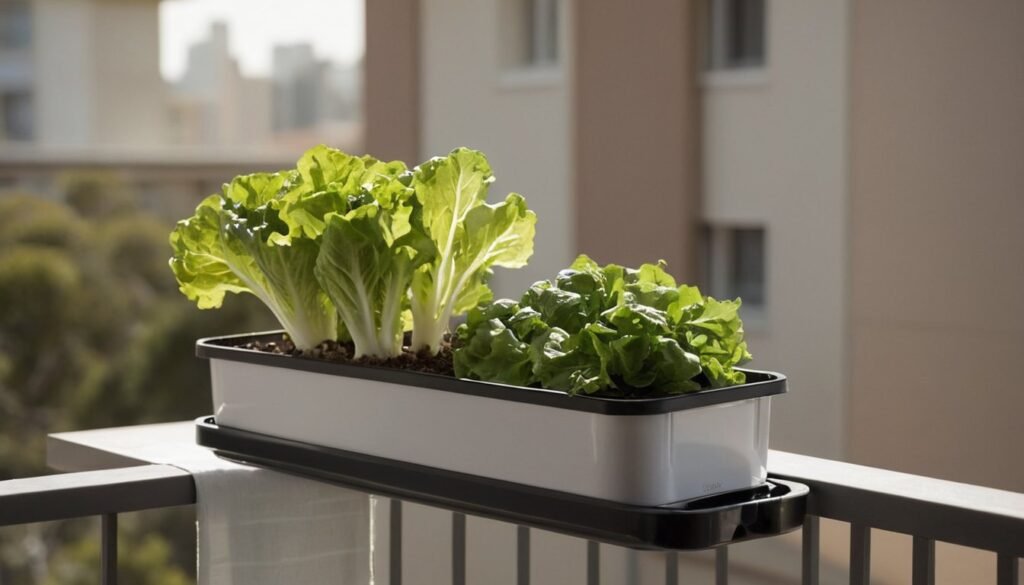
Succulents and other drought-tolerant plants are far less forgiving of wet feet. Our guide to tough succulents for full-sun spots explains how little water they need. If you struggle to keep up with watering, reservoir-style planters can steady moisture, but check how their overflow is handled so it does not end up on the floor.
How do you protect floors and the balcony below?
Water from a balcony does not stay on your balcony. It can run to the edge, along the floor, or drip through gaps. Take simple steps:
- Group pots on a tray or mat rather than scattering them near the edge, so runoff is caught in one place.
- Water in the cooler part of the day, which also reduces evaporation, and avoid watering just before you leave the house, so you can check for drips.
- Keep pots away from the edge and off railings, where overflow is most likely to land on someone below.
- Wipe up fertiliser and mix spills. Dark runoff from potting mix or fertiliser can stain light tiles, concrete and timber, and is easier to clean while fresh.
- Be considerate. If water has dripped onto a neighbour, apologise and fix the cause. It is a good-neighbour issue before it is a rule.
Your strata by-laws and building manager can confirm what applies in your building, including anything about watering, drainage and what you may attach to balcony surfaces.
How do you keep the balcony drain clear?
Many balconies have a floor drain or outlet. Leaves, potting mix and spent flowers wash into it and can block it, leaving water pooling on the floor.
- Sweep the balcony regularly, not hose it, so debris goes in the bin and not the drain.
- Keep the drain cover in place and free of litter.
- Do not stand pots over the drain, which blocks it and hides problems.
- After heavy rain, check that water is draining away.
- If water pools or a drain seems blocked, report it to your building manager rather than attempting repairs yourself.
For a wider look at what suits a balcony, see our complete guide to balcony gardening across Australia.
What is established and what depends on you?
Established: pots need drainage holes, wet soil favours root rot, standing water in pot bases can breed mosquitoes, and raising pots keeps holes clear.
Depends on your situation: how often to water, whether a saucer helps or hurts, how fast saucers fill in your wet season, and what your building allows. When in doubt, check your strata by-laws, ask your building manager and watch your own balcony after one watering.

 By anastasnowla@gmail.com

No comment yet, add your voice below!